Capital gains are a huge share of the income of the wealthiest households, and under current law gains are only taxed when an asset is sold. Buy-and-hold investors can defer indefinitely, and the step-up in basis at death wipes a lifetime of gains off the ledger. Taxing gains as they accrue closes that gap … on paper. In practice, two cases tell a different story, one that turns out very badly for people who should not be punished by our tax system.
Case 1 — The farmer next to a data center
Consider a family that runs a 4,000-acre row-crop operation. The corn they grow pays what corn pays — about $600,000 of net cash income a year. Then, in year 3 of our simulatoin, a AI company announces a data-center campus 15 miles away. Speculators bid the surrounding farmland from $10,000 to $30,000 an acre over four years.
The farm’s real activity hasn’t changed. But on paper the farm is now worth over $120M, well past a $50M wealth threshold. At a 20% mark-to-market tax on the paper gain:
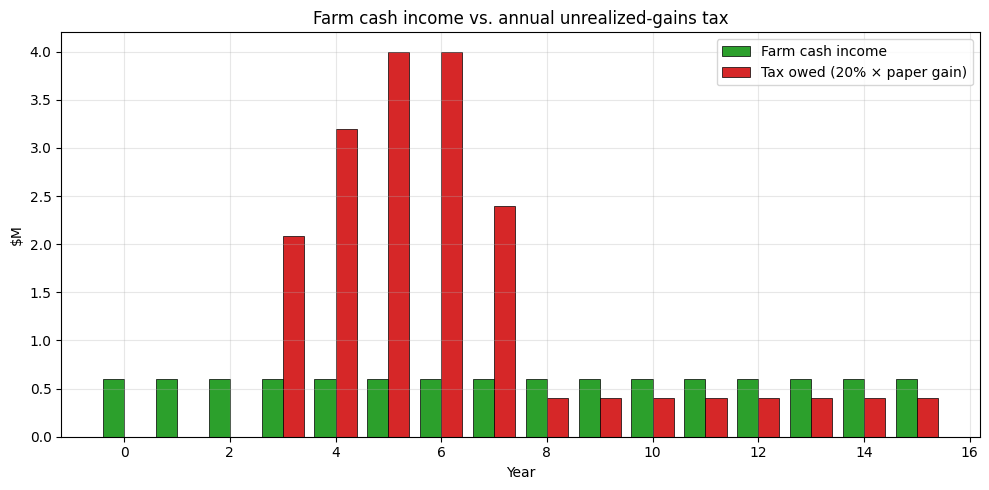
| Annual cash income | Worst-year tax | Tax ÷ income that year | 16-yr cum. tax | 16-yr cum. income | Acres to sell |
|---|---|---|---|---|---|
| $600k | $4.0M | 6.7× | $18.9M | $9.6M | 422 (11%) |
The bad outcome: there is no way to pay the tax from operations. To stay current the family must sell off acres — probably to the same developer-class buyer who caused the price spike. The policy accelerates the conversion of family farmland into commercial use. And if the data-center plan falls through and land prices drop, prior years’ tax is not refunded.
Walk through the farmer scenario →
Case 2 — The founder of a failed startup
A founder owns 40% of her venture-backed startup. She paid roughly nothing for her founder shares. The company raises priced rounds; by year 5 her stake is paper-worth $160M, but this startup fails like most do, and by year 10 the company has wound down and the stake is worth zero. Throughout, the shares are illiquid — the cap table forbids secondary sales and her actual salary is $250k.
Each up-round produces an unrealized “gain” that the tax bill is computed against. Down-rounds produce paper losses, but they aren’t refundable: at best they roll forward against future gains that never arrive.
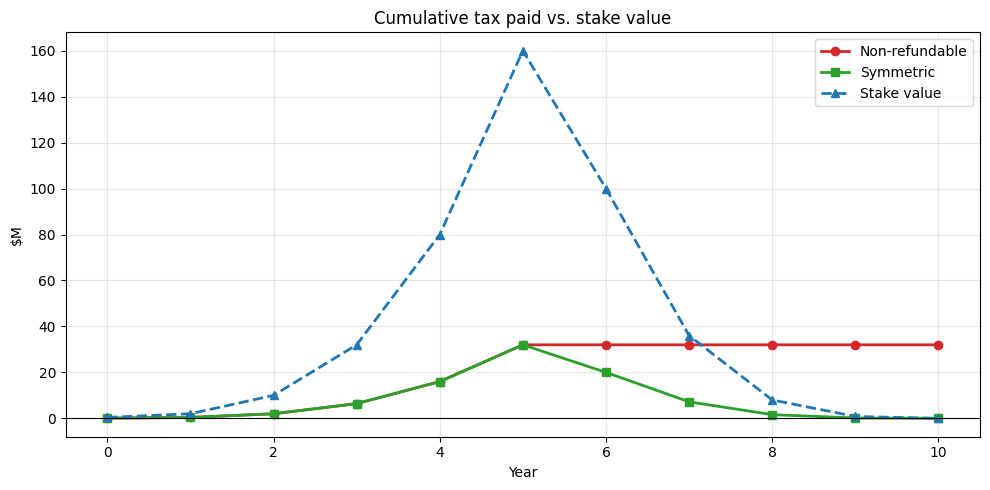
| Peak paper stake | Final stake | Total cash tax | Worst-year tax | Tax ÷ salary that year | Net outcome |
|---|---|---|---|---|---|
| $160M | $0 | $32M | $16M | 64× | −$32M |
The bad outcome: she pays tens of millions in real cash on paper money against a stake that ends up worthless. The only way to pay the worst-year bill is a forced partial sale of the company at the current paper mark — which depresses that mark and triggers the same problem for everyone else subject to the tax. The “symmetric” alternative — let the IRS refund losses — is mathematically clean (net tax ≈ $0) but politically untenable: it requires the Treasury to mail multi-million-dollar checks to wealthy households in bust years.
Walk through the entrepreneur scenario →
Case 3 — The public-company founder who has to move his own stock
A founder owns 20% of a publicly traded company with a $5B market cap. Over one year the company grows to $7B — his paper gain is $400M and the 20% tax is $80M. He has no other liquid wealth. To pay the tax he has to sell stock.
That’s where the second-order math kicks in. A $5–7B-cap stock typically trades about 0.7% of its market cap a day, so daily volume is around $30–50M. Pushing $80M of insider supply through a stock like that is roughly 1.6 days of total volume, and there is thirty years of empirical work on what that does to price. Two serious bodies of literature disagree about the functional form — Almgren et al. (2005) explicitly reject the square-root model in favor of a linear permanent / 3/5 temporary law; Tóth et al. (2011) derive a square-root law from a latent-order-book model and support it empirically. We compute under both. Both predict a permanent price drop in the 3–5% range, applied not just to the shares he sells but to the ~19% of the company he still holds.
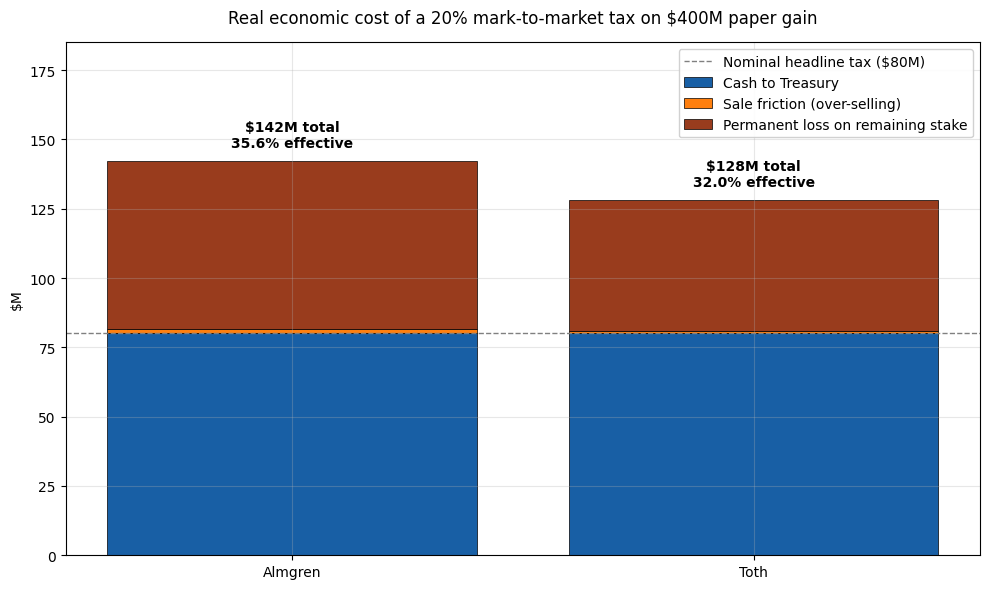
| Model | Cash to Treasury | Sale friction | Permanent loss on remaining stake | Total cost | Effective rate on gain |
|---|---|---|---|---|---|
| Almgren (linear perm.) | $80.0M | $1.5M | $60.8M | $142.3M | 35.6% (1.78× nominal) |
| Tóth (square-root perm.) | $80.0M | $1.0M | $47.1M | $128.2M | 32.0% (1.60× nominal) |
The bad outcome: the headline 20% tax rate ends up being a 32–36% effective rate on his paper gain, because the forced sale permanently lowers the value of the stake he still holds. The permanent price drop is also borne by every other shareholder — index funds, pension plans, retail. A wealth tax on the founder is, in part, a value transfer from every other holder of the same security to the Treasury. And it repeats every year the company grows: ownership erodes monotonically.
Walk through the public-company scenario →
Case 4 — “Buy, borrow, die”: does the loophole really zero out tax?
The cases above were arguments against an annual mark-to-market tax. This last case is the opposite — an argument that the existing tax code already catches most of the wealth the unrealized-gains-tax proposal was trying to reach, and the popular “buy borrow die zeroes out tax” narrative is wrong above the estate-tax exemption.
A 65-year-old wealthy taxpayer with appreciated stock wants to fund a major expenditure today. He has three financing paths over the next 25 years (age 65 → 90): sell stock upfront, borrow and amortize, or borrow-interest-only and die with the loan outstanding. The last path is the textbook buy-borrow-die: step-up in basis at death wipes out the capital-gains tax on the loan-repayment sale. So the strategy “works” in the sense that no capital-gains tax is owed.
But total federal tax revenue isn’t zero. The estate tax (40% above the $30M MFJ exemption) takes a much bigger bite than the avoided capital-gains tax would have.
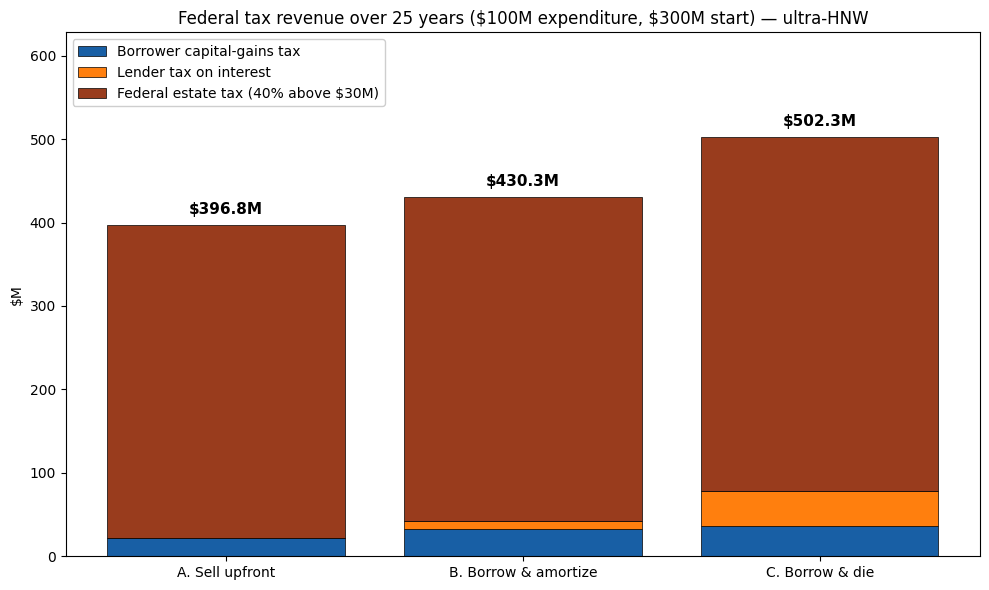
For an ultra-HNW founder ($300M portfolio, $100M expenditure, age 65 → 90):
| Scenario | Borrower CGT | Lender tax | Estate tax | Total fed | Heirs |
|---|---|---|---|---|---|
| A. Sell upfront | $21.7M | — | $375.0M | $396.8M | $592.5M |
| B. Borrow & amortize | $32.4M | $9.8M | $388.1M | $430.3M | $612.1M |
| C. Borrow, die | $36.7M | $41.3M | $424.4M | $502.3M | $666.7M |
The bad outcome — for the popular narrative, not the founder. “Buy borrow die” still wins for heirs (~12% more than selling upfront, because the strategy preserves capital base for 25 years of compounding). But it loses for the popular tax-avoidance story: the IRS collects more federal revenue under Scenario C than under A, not less, because the 40% estate tax replaces the 23.8% capital-gains tax on a bigger compounded estate. Total federal revenue runs 3–5× the original expenditure over the 25-year horizon — almost all of it estate tax.
The targeted reforms are clear and existing-tax-code-compatible: eliminating step-up at death closes the genuine loophole; tightening the estate-tax exemption or its valuation games (GRATs, IDGTs, dynasty trusts) addresses dynastic-wealth concentration directly. Both have substantial leverage; neither requires the mechanical breakage of an annual unrealized-gains tax.
Walk through the buy-borrow-die analysis →
Why these aren’t edge cases
The first three cases follow from the same four mechanical properties of any annual mark-to-market tax. The fourth shows that the existing tax code already collects substantial revenue from the very households the proposal is supposed to target.
The mechanical problems with an annual mark-to-market tax:
- Liquidity: the tax is owed in cash; the gain is on an asset that often cannot be sold.
- Valuation: for anything other than public stock, “this year’s value” is an appraiser’s opinion, not a market price.
- Asymmetry: taxing gains without refunding losses is a one-way ratchet; refunding losses turns the Treasury into a co-investor that writes checks during recessions.
- Constitutional risk: Moore v. United States (2024) left open whether unrealized gains are “income” within the 16th Amendment. A federal mark-to-market regime faces immediate litigation before it raises a dollar.
The cleaner alternatives
- Close step-up in basis at death. Tax the embedded gain at the transfer event. Same revenue target, no annual valuation, no liquidity squeeze.
- Tax loans against unrealized assets as constructive realization. If a household borrows large sums against stock to fund consumption, treat that as a sale of the pledged shares for tax purposes.
- Mark-to-market only publicly traded securities held by ultra-wealthy households. Narrow base, observable prices, fewer cliff effects — still imperfect, but tractable.
None of this is an argument that the current system is fair. It’s an argument that “tax unrealized gains annually, across all asset classes” is the version of the fix with the worst mechanical properties — and that the cleaner reforms get most of the revenue with a fraction of the breakage.